Fundamentals of Electric Circuits
DC linear circuit elements, KCL/KVL, Thévenin and Norton equivalents, nodal analysis, operational amplifiers, transient and sinusoidal steady-state response, phasors, power, frequency response, and resonance.
Education
Undergraduate and graduate courses in circuits, semiconductor physics, electronic devices, and optical materials.
Undergraduate
DC linear circuit elements, KCL/KVL, Thévenin and Norton equivalents, nodal analysis, operational amplifiers, transient and sinusoidal steady-state response, phasors, power, frequency response, and resonance.
Principles of quantum physics applied to semiconductors: wave–particle duality, Schrödinger’s equation, energy quantization, tunnelling, electrons in crystalline semiconductors, and concepts underlying microelectronics and optoelectronics.
Semiconductor materials, carriers, and transport; operation and design of PN and Schottky diodes, MOSFETs, bipolar transistors, and optoelectronic devices, including TCAD-based design projects.
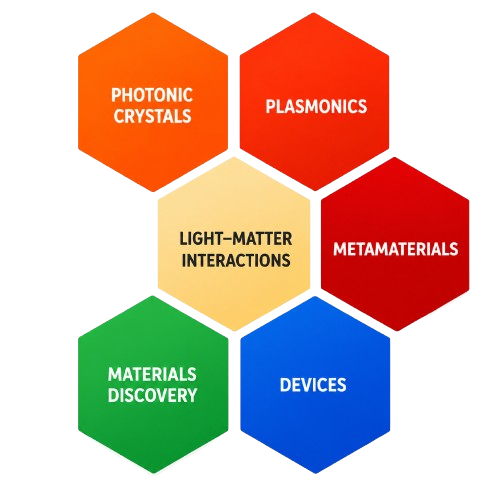
Light–matter interaction for optical and photonic materials, spanning wave optics, lasers, interference, fibre optics, diffraction, photonic crystals, metamaterials, and plasmonics.
Graduate
Solid-state physics with emphasis on semiconductors: crystal symmetry and dynamics, electrons in periodic lattices, transport theory, excess carriers, and semiconductor surfaces.
Topics vary by year; generally covers elements of solid-state physics relevant to semiconductor devices.
Graduate treatment of optical and photonic materials for telecommunications, sensing, spectroscopy, and related fields, including lasers, coherence, fibre optics, photonic crystals, metamaterials, and plasmonic materials.
Nuclear science, engineering, and applications: atomic and nuclear physics, nuclear materials, reactor physics, radiation fundamentals, radioisotopes and nuclear medicine, advanced materials for next-generation reactors, SMRs, fusion, and energy sustainability.
Nuclear engineering fundamentals including thermal hydraulics and power systems, corrosion chemistry and materials degradation, structural requirements, non-destructive evaluation, and nuclear systems operations, robotics, and AI.
Related programs
AEMS UToronto
Summer courses and frontier STEM education in energy, materials, and photonics for motivated students.
Explore AEMS Academy →INFORM
An interdisciplinary graduate course exploring matter, knowledge, and meaning across science and the humanities.
Explore Foundations Matter →